Haringey

§ This page gives an overview of the Haringey local authority district, bringing together key facts, maps, and data to help you quickly understand the area. This is one of 361 LAD profiles on Baseview.
Overview ⁞ Haringey in North London features a diverse mix of communities and landscapes, from the urban bustle of Wood Green to the leafy heights of Highgate and Crouch End. It is home to Alexandra Palace, Tottenham Hotspur Stadium, and large parks like Finsbury Park.
Haringey Boundary Map
This map shows the official boundary of the Haringey local authority district, based on the latest geographic data published by the Office for National Statistics (ONS). It provides a clear view of the district’s extent and helps you understand how the area fits within the wider regional and national landscape.
Contains OS data © Crown copyright and database right 2025. Source: Office for National Statistics licensed under the Open Government Licence v3.0.
The administrative boundary of Haringey can also be viewed on OpenStreetMap: District Boundary of Haringey.
Key Facts about Haringey
What region is Haringey in? Haringey is in the Greater London, an administrative region and a ceremonial county in England.
Is Haringey a city? No, Haringey is not a city. (Note: the UK has 76 officially designated cities.)
Who governs Haringey? The local government for this district is: The London Borough of Haringey (London Borough).
▶ Official website of The London Borough of Haringey 🔗 haringey.gov.uk
Which police force covers Haringey? Policing in Haringey is provided by Metropolitan Police Service 🔗 met.police.uk, which serves 32 London Boroughs.
Haringey in International Geographies
In the International Territorial Levels (ITLs) hierarchy, Haringey is within an ITLs Level 3 area:
- (ITL 1) London
- (ITL 2) ⇒ Inner London - East
- (ITL 3) ⇒⇒ Haringey and Islington
The International Territorial Levels are used by OECD member countries for statistical purposes to classify administrative areas. We have this listable page for easy browsing of ITL names and codes: International Territorial Levels.
Constituencies in Haringey
Haringey is divided into 4 parliamentary constituencies, listed below in alphabetical order.
A constituency is a specific geographical area that elects one Member of Parliament (MP) to represent them in the House of Commons. The United Kingdom is divided into 650 parliamentary constituencies, 75 of them are in Greater London (covering 32 London boroughs). We have this list page for easy browsing of all UK parliamentary constituencies: List of Constituencies.
Wards in Haringey
Haringey is divided into 21 wards, listed below in alphabetical order.
- Alexandra Park
- Bounds Green
- Bruce Castle
- Crouch End
- Fortis Green
- Harringay
- Hermitage & Gardens
- Highgate
- Hornsey
- Muswell Hill
- Noel Park
- Northumberland Park
- Seven Sisters
- South Tottenham
- St Ann's
- Stroud Green
- Tottenham Central
- Tottenham Hale
- West Green
- White Hart Lane
- Woodside
In the UK, a ward is a subdivision of a local authority area, used mainly for electoral and statistical purposes. Defined by the ONS, wards represent the primary unit for local elections, each returning one or more councillors to the local council. Wards are also used as a key geography for presenting population and census data. We have this list page for easy browsing of all electoral wards: List of all Electoral Wards in the UK.
Parishes in Haringey
Haringey is entirely unparished—there are no civil parishes in this local authority district.
Parishes are the lowest tier of local government; where they don’t exist, those very local services and representation sit directly with the principal council. We have this list page for easy browsing of all parishes: List of Civil Parishes in England and Wales.
Built-up Areas in Haringey
Haringey covers 4 built-up areas, listed below in alphabetical order.
- Barnet *
- Enfield *
- Hackney *
- Haringey *
In the UK, a Built-up Area (BUA) is a continuous urban area of at least 20 hectares (0.2 km²), defined by the ONS as land where buildings are generally no more than 200 metres apart, such as towns, cities, or large villages. (Note: A BUA name marked with an asterisk (*) indicates that the area is situated partly in the district of Haringey.)
We have this list page for easy browsing of all built-up areas: List of all Built-up Areas in GB.
Railway Stations in Haringey
Haringey is served by a number of National Rail stations, providing rail connections to nearby towns, cities, and destinations across Great Britain. The railway stations listed below are located within the Haringey Local Authority District and are grouped by train operating company for clarity.
- Govia Thameslink Railway (Great Northern) ▸ Alexandra Palace (N22 7ST) ⁞ Hornsey (N8 9DJ) ⁞ Harringay (N4 1RE) ⁞ Bowes Park (N22 4NT)
- Greater Anglia ▸ Tottenham Hale (N17 9LR) ⁞ Northumberland Park (N17 0HY)
- London Overground ▸ Seven Sisters (N15 5LA) ⁞ White Hart Lane (N17 8HG) ⁞ Harringay Green Lanes (N4 1DR) ⁞ Bruce Grove (N17 6QA) ⁞ South Tottenham (N15 6UJ)
This is a district-level view only. For a complete list of all National Rail stations across Great Britain, see the UK National Rail Stations Directory.
Haringey compared with other districts in the UK
This section shows how Haringey compares with other local authority districts in the UK, using a variety of measures and rankings.
Haringey has 21 electoral wards.

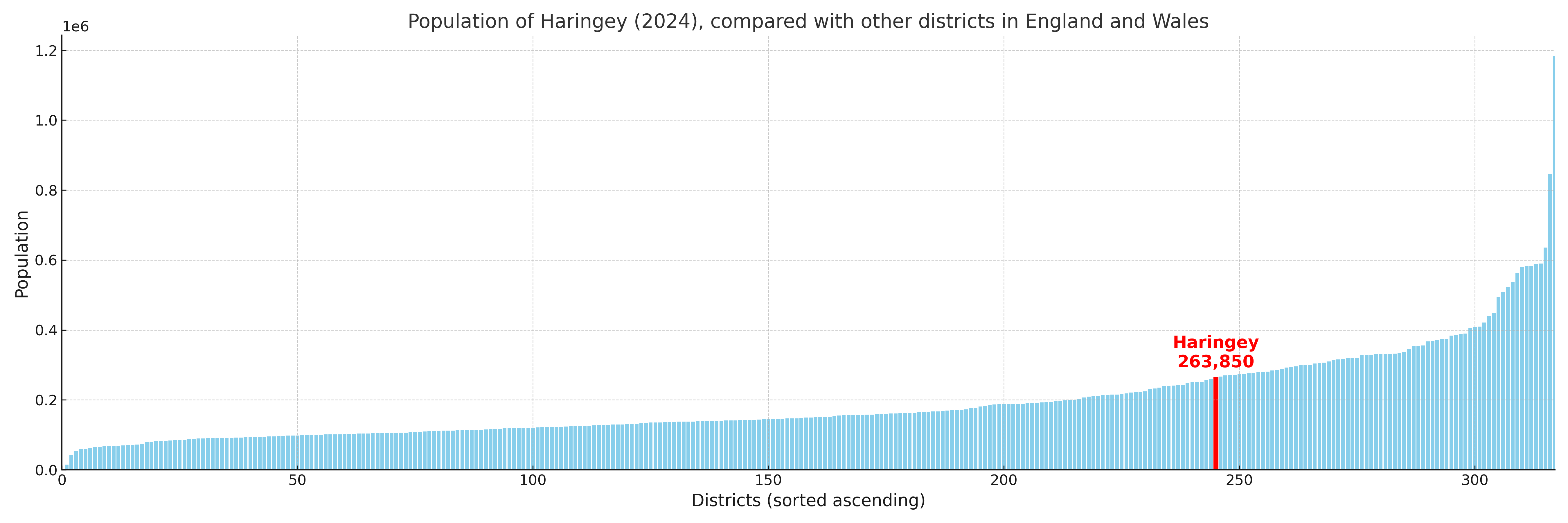
Haringey has a population of 263,850 (2024 mid-year estimate by ONS)
Population and Migration Trends in Haringey
This chart shows the population trend for Haringey from 2015 to 2024. It provides a quick overview of whether the local authority is growing, stable, or declining over time, and helps set context for the migration patterns shown below.
Population change is influenced by natural change (births minus deaths) and migration. The net migration chart below focuses on migration, separating internal migration (moves within the UK) from international migration (moves to and from abroad). Positive values indicate net inflows, while negative values indicate net outflows. The rate labels (per 1,000 residents) help compare migration intensity across years, even when the population size changes.
More local statistics and data for Haringey can be found on the ONS statistics for Haringey.
Latest news about Haringey
Use the search box, or suggested search phrases, below to find recent news, council updates, planning stories, housing developments, transport changes, public services news, local elections, community issues and other local developments related to Haringey. Results may include coverage from UK national, regional and local news websites, as well as official public-sector and local democracy sources.
- Haringey council
- Haringey planning
- Haringey local elections
- Haringey housing
- Haringey transport
- Haringey regeneration
- Haringey public services